The short answer is No.
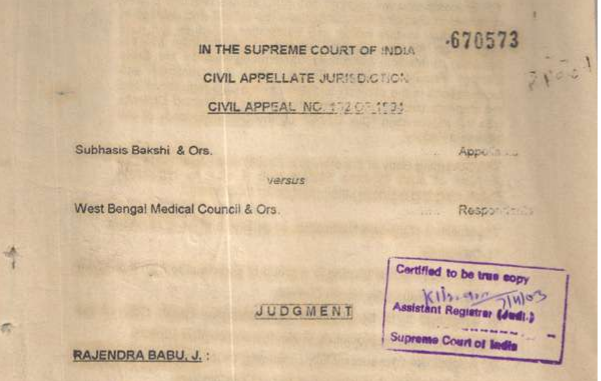
In recent years, several educational institutions—predominantly private—have begun offering 1-2 year diploma courses in modern medicine, claiming that these programs allow graduates to practice allopathy without completing a formal medical degree such as MBBS. These claims are commonly justified by citing a Supreme Court judgment in Subhasis Bakshi & Others v. West Bengal Medical Council & Others (2003).
According to these institutions, the Supreme Court has “legalised” CMS-ED diploma holders to open primary health centres and treat basic illnesses, particularly in rural areas. This interpretation is incorrect. The judgment has been selectively misinterpreted to persuade students to enrol in such courses.
What Is CMS-ED?
CMS & ED (Community Medical Service & Essential Drugs) is a diploma-level program intended to train individuals for basic primary healthcare delivery in rural areas.
The course generally focuses on:
- Management of common illnesses
- Use of basic WHO-recommended medicines
- Elementary preventive and community healthcare
CMS-ED programs are usually offered under vocational or skill-development categories and are not recognised as medical qualifications by statutory medical regulators in India.
Who Is Legally Permitted to Practice Medicine in India?
Medical education and professional practice in India are regulated by the National Medical Commission (NMC). A person may practice allopathic medicine only if registered in the official medical registers.
Medical Registration Structure in India
- State Medical Registers (SMRs) – State-level registers that grant legal authority to practice medicine within the state and enable disciplinary control.
- National Medical Register (NMR) – A centralised register maintained by the NMC, containing the names of all licensed medical practitioners.
Only qualifications recognised under the regulatory framework of the NMC are eligible for registration. CMS-ED is not a recognised medical qualification and does not grant a licence to practice allopathic medicine.
Supreme Court Judgment on CMS-ED
Historically, in West Bengal, holders of CMS or similar rural health diplomas were engaged by the state government to staff health centres and subsidiary health centres. They were permitted to treat certain common ailments under government practice.
In Subhasis Bakshi & Others v. West Bengal Medical Council & Others, the Supreme Court did not hold that CMS diploma holders are entitled to practice allopathic medicine. But simply prevented administrative hypocrisy.
How the Judgment Is Commonly Misinterpreted
The judgment is often selectively quoted to claim that the Supreme Court allowed CMS diploma holders to practice allopathy, including prescribing medicines and issuing certificates.
What the Court Actually Held
- The ruling was confined to the State of West Bengal
- It was based on specific state notifications in force at that time
- Registration, if any, was limited to a State Register for restricted purposes
- No nationwide or unrestricted right to practice was granted
The Court merely held that if the State legally permits such diploma holders to treat limited conditions, it cannot deny ancillary powers (like prescribing medicines or issuing basic certificates) that are necessary to exercise that limited permission.
The Critical Distinction Often Ignored
- Limited permission to treat does not amount to a general right to practice allopathy
- State-specific rural health exceptions do not create nationwide recognition
The verdict prevented administrative inconsistency but did not create doctors or legalise diploma-based allopathic practice.
Correct Legal Position Today
For General Allopathic Practice
- A recognised medical qualification
- Registration under central medical law
For CMS or Similar Diplomas
- Practice only if explicitly permitted by a state statute or notification
- Strictly limited scope of work
- No legal protection outside that statutory framework
National Medical Commission Act, 2019 – Section-32
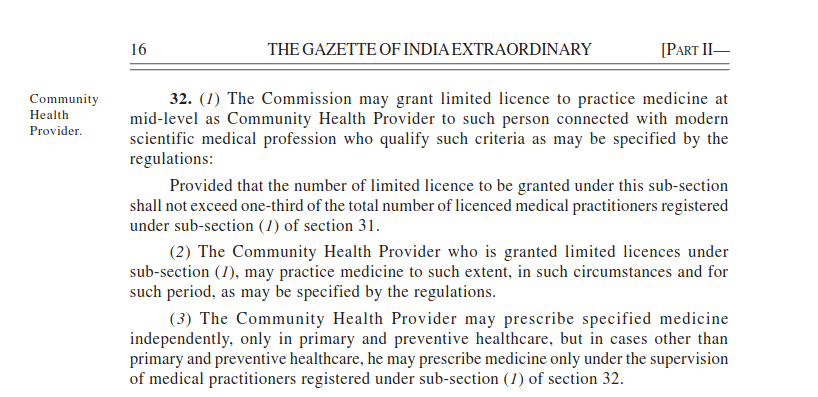
There is often confusion regarding Section-32 of the NMC Act, 2019. This section allows the granting of limited licenses to "Community Health Providers" (CHPs) to practice medicine at a mid-level.
Section-32 of the National Medical Commission Act, 2019, provides for a limited licence to practice medicine at a mid-level as a Community Health Provider (CHP).
- Independent prescribing is limited to primary and preventive healthcare
- Supervision is mandatory for all other forms of medical care
- The number of CHPs cannot exceed one-third of licensed medical practitioners
- Implementation depends on detailed regulations framed by the NMC
This provision does not automatically legitimise CMS-ED diploma holders or grant them independent allopathic practice rights.
The Act establishes the structure, but additional NMC regulations are required to clarify criteria, training, and the precise area of activity for CHPs. In summary, Section-32 establishes the groundwork for CHPs, but their widespread deployment is dependent on the NMC establishing and implementing the required regulatory frameworks.
Conclusion
CMS-ED holders cannot practice allopathy independently. Doing so outside of very specific, state-sanctioned rural programs puts the practitioner at risk of legal action for "quackery." Claims suggesting otherwise rely on selective interpretation of judicial decisions.
Until expressly recognised by statute and regulation, independent allopathic practice remains restricted to duly qualified and registered medical practitioners.
References